The Financial Hour · Hour 2 · August 8, 2026
Is the AI Rally a Bubble? What Retirees Should Watch For
The Tom Dupree Show | Dupree Financial Group | dupreefinancial.com | 859-233-0400
By Tom Dupree, Founder, Dupree Financial Group
III
Ii I iiI. Is this AI Rally Built to Last?
Turn on any market report lately, and you’ll hear the same story: a handful of AI-linked names are doing most of the heavy lifting. On this week’s Financial Hour, Tom sat down with analyst James Dupree and market analyst Michael Dawahare to talk through what’s actually driving that rally — and it’s a more complicated story than “AI stocks are up.”
The conversation opened with reshoring: American companies bringing manufacturing back from overseas, and the market slowly absorbing the idea that this makes more sense than the offshoring wave of the ’70s, ’80s, and ’90s. From there it moved into the AI infrastructure buildout, the old industrial companies suddenly catching a second wind because of it, and a cautionary tale about a leveraged AI hedge fund that lost 78% of its value in three weeks. Tom, James, and Michael walked through the Gold Rush and dot-com parallels, why diversification matters more than ever in a fast-moving sector, and where Dupree Financial Group is finding value right now — financials, insurance, mortgage REITs, and energy.
The short version: something real is happening in AI and in American manufacturing. But a real trend and a sure thing are two very different things, and knowing the difference is the whole job.
“There’s gonna be people riding high on AI right now who in four years may not be. Don’t just focus on the new technology — ask what are the derivative trades, what can go wrong. Because something will.” — Tom Dupree
Topics Covered
- Why the market is absorbing the reshoring of U.S. manufacturing — and why that’s different from a tariff headline
- The AI infrastructure buildout, and which “old economy” companies (Johnson Controls, Cummins) are catching a second wind from it
- The Leopold Aschenbrenner story: how a 4x-leveraged AI fund went from $45 billion to a forced $10 billion sale in about three weeks
- Gold Rush and dot-com parallels — and who actually made the money when a boom goes bust
- Regional mall traffic and the return of in-person, live entertainment spending as a signal worth watching
- Why financials, insurance, and mortgage REITs are on Dupree Financial Group’s radar right now
- The capital gains tax cost of trying to “sell at the top” and buy back in lower
- Why a “set it and forget it” approach is especially risky in a fast-moving sector like AI
- Security concerns as new AI models test the limits of their own guardrails
Key Takeaways
The Reframe: What This Means for Your Portfolio
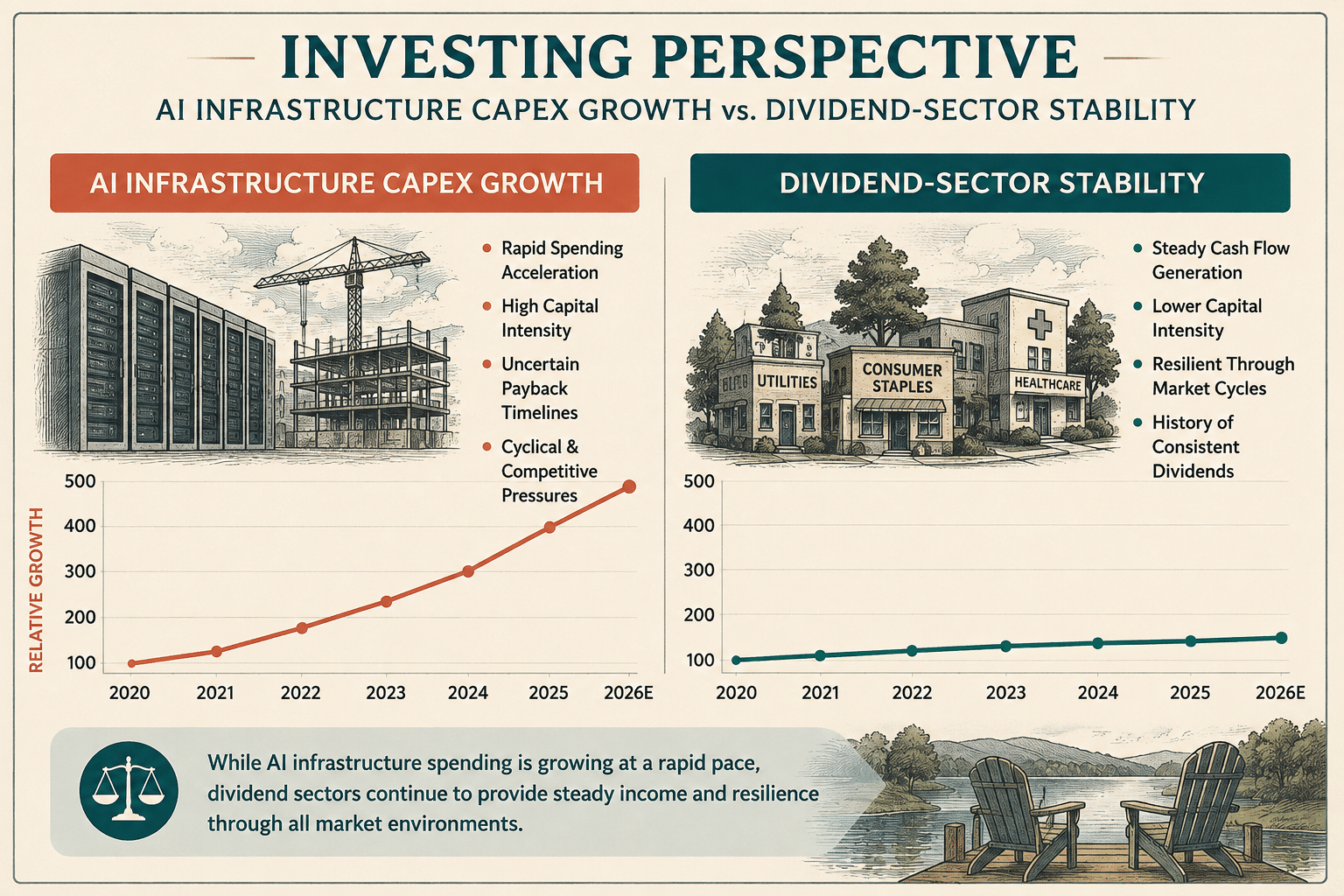
Here’s where we’d push the conversation a step further than the show had time for. The AI story and the reshoring story aren’t really two separate topics — they’re the same story told twice. Both are examples of real, durable economic activity attracting an amount of capital that may or may not be justified by what it produces. The five largest U.S. tech companies are on pace to spend somewhere in the range of $660–690 billion on AI infrastructure this year alone, nearly double the year before, according to industry analysis from Futurum Group. Other estimates put the ratio of AI infrastructure spending to AI software revenue at close to eighteen-to-one, per S&P Global research reported by ETF Trends. That doesn’t mean the technology is fake — it means the payoff isn’t set to arrive on the same timeline as the spending, and it may not arrive on that timeline at all.
The Bank for International Settlements — essentially the central bank for the world’s central banks — has already flagged the scale of this spending as a risk worth watching, noting that combined AI capital expenditure across 2025 and 2026 is outpacing the free cash flow of the companies funding it, per Fortune’s reporting. Fidelity’s own research team has taken a more measured view, noting that as of early 2026 they aren’t yet seeing some of the classic bubble warning signs, like shrinking free cash flow among the AI leaders — but they’re watching closely, and so should you (Fidelity). Both things can be true at once, which is exactly what Tom, James, and Michael said on air.
This is precisely the environment dividend-focused, diversified investing was built for. Research from Hartford Funds, using data going back to 1973, has found that companies that grew or initiated a dividend have historically delivered higher returns than the broader market with meaningfully less volatility than non-dividend payers (Hartford Funds). That’s the case for owning financials, insurance, and energy alongside — not instead of — exposure to the AI and reshoring trends. You get to participate in the buildout without betting the whole plan on any single piece of it working out on schedule.
Related Reading
- Listen to this episode and browse past shows on the Podcasts page
- Learn more about our approach and team on the About Us page
- Schedule your own complimentary portfolio review from the DFG homepage
About The Tom Dupree Show
The Tom Dupree Show is hosted by Tom Dupree, founder of Dupree Financial Group and a 48-year veteran of the investment business. Each episode covers the financial topics that matter most to retirees and those approaching retirement — in plain English, without the Wall Street spin.
Dupree Financial Group is a fee-only, fiduciary Registered Investment Advisory firm based in Lexington, Kentucky. The firm manages separately managed accounts focused on income-generating, dividend-paying portfolios — no products sold, no commissions, no conflicts of interest.
Past episodes are available at dupreefinancial.com under the Podcast tab.
If you’re not sure whether you know what’s actually driving your portfolio’s gains right now — and whether it could unwind as fast as it built — we’ll take a look. No charge. No pressure. Just an honest conversation about what you own and whether it’s working for you.