Dupree
Financial Group
Podcast Show Notes
The Tom Dupree Show
Episode  ·  September 19, 2026

The Fed Raised Rates: What Rising Interest Rates, Oil Prices and Market Volatility Mean for Retirement Income

The Tom Dupree Show | Dupree Financial Group | dupreefinancial.com | 859-233-0400

Episode Description: Fed Rate Hike, Oil Prices and Your Retirement Income

The Federal Reserve just raised interest rates by 25 basis points, oil and diesel prices are still climbing, and the stock market has been choppy for the better part of a month. If you are living on your retirement income, or getting close to it, that mix of a Fed rate hike, rising interest rates and stock market volatility can make even a calm investor check the account balance more often than usual. On this week’s Financial Hour, our team of portfolio managers and analysts sorted through what actually happened, what it means for dividend paying stocks and bonds, and why we start with income, not headlines.

At Dupree Financial Group in Lexington, Kentucky, we manage retirement money for a living, so we listen to this kind of news through one filter: what does it mean for the income our clients depend on? Joining the conversation this week were Michael Dawahare, Mike Johnson and James Dupree, and they covered a lot of ground, from the Fed and the bond market to oil, geopolitics, the midterm elections, and how we manage a dividend income portfolio when prices swing. The show also opened with a little Kentucky music talk about Sturgill Simpson and his alias, Johnny Blue Skies.

“Inflation doesn’t retire when you do, and a volatile market doesn’t care about your timeline.”
Tom Dupree, in a Dupree Financial Group spot that aired during this week’s show

Topics Covered

  • The Fed’s 25 basis point rate hike and why the bond market barely reacted
  • Oil, diesel and inflation, and why our hosts called this an energy shock, not a supply shortage
  • Iran talks, China’s oil buying, Ukraine and the midterm elections
  • Stock market volatility, AI stocks and the Russell pullback
  • Why long term forecasts, like a well known 2016 McKinsey study, deserve humility
  • The yen carry trade, explained in plain English
  • How we research company fundamentals and manage dividend income for retirees

Key Takeaways

  • The Fed raised rates by 25 basis points, and the bond market barely flinched. The hike was widely expected, roughly a 90% chance was already priced in, and the 30 year Treasury yield sat below its recent peak afterward.
  • Oil and diesel are running into a bottleneck, not a shortage. Our hosts described an energy shock caused by a disruption in one part of the supply chain, like Interstate 75 narrowing from three lanes to one.
  • Stocks have historically been used as an inflation hedge, though no strategy removes risk. Companies can pass higher costs along through prices. Dividends can also be reduced or eliminated, and stock prices can fall.
  • Long term forecasts have missed before, so we lean on charts and company fundamentals. A 2016 McKinsey study predicted lower returns, yet market returns since then have run well ahead of it. As one host said, price is truth.
  • A lower price on a company we already know can raise the yield on new purchases. That is why we do the research first. The fundamentals have to be intact before a dip becomes an opportunity, and results are never certain.

The Fed Raised Rates by 25 Basis Points: What Happened and Why It Matters

On Wednesday, the Federal Open Market Committee, the group inside the Federal Reserve that sets short term interest rates, raised its benchmark rate by a quarter of a point. You can read the committee’s own statements on the Federal Reserve’s FOMC page.

What a Basis Point Means in Plain English

A basis point is one hundredth of one percent. So 25 basis points is a quarter of a percentage point. It sounds small, and on any single day it is. But when it lands on top of higher oil prices and a market that has been jumpy, retirees notice.

The Move Was Already Priced In

One of our hosts explained that the market had seen this coming, with roughly a 90% chance of a hike built into prices before the announcement. Chair Kevin Warsh’s comments, the hosts noted, gave people room to argue the numbers alone did not call for a hike. He raised rates anyway, and the market took it in stride.

The reaction showed up on the yield curve, which is simply a line comparing what the government pays to borrow for a few months against what it pays to borrow for 30 years. The short end moved up a little. The 30 year Treasury yield peaked at roughly 5.4% and was sitting below that afterward. As one host put it, “the Fed is taking inflation seriously,” and that is what the bond market was reading into the decision.

Why the Fed Had to Act on Inflation

The hosts pointed to diesel crack spreads, which is just the gap between the price of crude oil and the price of the diesel refined from it, running at all time highs. In their view the committee had little choice. One host said “it would just defy reality to suggest that when diesel and oil do this, that it doesn’t lead to higher prices.”

That same host said he liked the message the decision sent to Washington: do not say there is no inflation when diesel costs are blowing out. The practical point is simple. Higher shipping costs work their way into groceries, restaurant menus and everything else that moves on a truck. And another host added that prices are sticky on the way down. “It’s not unusual to see the price never come back down.”

You can follow the official inflation numbers on the Bureau of Labor Statistics Consumer Price Index page.

Tom Dupree put it plainly in a Dupree Financial Group spot that aired during the show: “inflation doesn’t retire when you do, and a volatile market doesn’t care about your timeline.”

Oil Prices and the Energy Shock: A Bottleneck, Not a Shortage

Heading into the weekend, the hosts described a strange moment. America is producing more energy than it ever has, the Western Hemisphere is building decades of energy strength, and the OPEC name has faded in importance. And yet there is an energy shock.

The explanation was a bottleneck, not a shortage. One host compared it to Interstate 75 North going from three lanes to one lane, where you get a short term disruption even though there are plenty of cars and plenty of road behind the slowdown. In his words: “We do not have a supply problem. We’re swimming in it. We just can’t get it to where it needs to go right now.”

The hosts also pointed to refinery closures in California and other places as part of the reason the fuel cannot move where it is needed. For more background on how diesel is made and priced, the U.S. Energy Information Administration’s diesel overview is a plain English place to start.

Why Stocks Have Historically Served as an Inflation Hedge

When prices rise, businesses generally raise theirs too. One host explained the logic: “that’s why equities, stocks, companies, are typically a good inflation hedge.” Companies pass higher costs along, those higher prices tend to stick, and that shows up in company margins. Historically, the host said, ownership in public companies has been the strongest hedge against inflation.

That is an observation about history, not a promise about the future. Dividends can be reduced or eliminated, stock prices can fall, and all investing involves risk, including possible loss of principal. For a refresher on how dividends work, the SEC’s Investor.gov dividend glossary explains it clearly.

The Geopolitical Backdrop: Iran, China, Ukraine and the Midterms

A large part of the show covered world events that are moving oil and markets. These are our hosts’ on air opinions, offered as market context, not predictions.

Iran Talks and the Week Ahead

The hosts noted that the State Department approved an Iranian delegation to travel to the United Nations next week, where they are expected to meet Gulf counterparts. That is a day or two after Chairman Xi and President Trump meet in Washington, so several pieces are in place for a possible agreement toward the end of next week.

One host described the long Sunni and Shia divide between Saudi Arabia and Iran as a 1,200 year chasm that is not likely to be resolved, but said there could still be room for some kind of compromise. He also argued that if a single outpost of Iran’s Revolutionary Guard fires a missile or drone, that should not derail an understanding already drafted by political leaders, because those leaders cannot control every outpost. Everybody, he said, has an incentive to make a deal, including Saudi Arabia, whose budget is being hit harder than it has been in years with both the Straits and the Red Sea diminished.

China’s Oil Buying

The hosts said China gets roughly 80% of its oil from Venezuela and Iran, at prices they described as roughly 30% to 60% below the spot market, and that both of those supplies are now gone other than some black market activity. China went on a buying spree in recent weeks, which the hosts said is part of the spike in oil and diesel, and it coincided with the Houthis disrupting part of the Red Sea. Their summary: this is not a supply issue. It is an energy shock caused by a disruption in one part of the supply chain.

Ukraine, Russian Refineries and the Midterm Elections

One host argued that much of the world has an incentive to see the midterm elections go against President Trump. As evidence, he pointed to Ukraine hitting Russian diesel refineries about a week ago for the first time since the war began, at a moment when Zelensky was meeting Canada’s Mark Carney, who talked about supplying drones and Ukraine joining NATO in some form. That host’s read was that the whole world is throwing everything it can at the midterms.

The hosts also noted that Jamie Dimon, who is not known as a Trump supporter, has backed what the administration is doing on Iran, warning that if Iran gets a nuclear weapon, Saudi Arabia and other Gulf states may follow. The point one host made is that the thing pressuring markets right now is the West finally confronting a major sponsor of terrorism, and that is what makes this moment unusual.

Stock Market Volatility: Where the Major Indexes Stand

From mid August through today, the major indexes have pulled back. One host walked through the numbers over roughly the past month:

  • The Russell, which tracks smaller companies and has led returns this year, pulled back about 6%
  • The S&P Equal Weight index pulled back about 4.7%
  • The Dow pulled back about 3.8%, or roughly 4%, from its August highs

Smaller companies tend to be the most exposed to higher interest rates and higher oil prices, which is why the Russell took the biggest hit. The host also noted this is not the first oil spike this year. Oil jumped from the end of February through April, then settled back to somewhere in the mid 70s to 80 range, and the market recovered. What is different this time is that interest rates have also climbed, and by more than they did earlier.

The major indexes are still only a few percentage points from all time highs, but the hosts said the choppiness is jolting because people get used to low volatility quickly. Some individual sectors are swinging wildly. Historically, they added, that is when opportunities show up, because a one event shock can push particular sectors around.

Midterms, AI Stocks and the Reshoring Trade

The crux, the hosts said, is policy. Nobody knows what policies will look like after November, and some of what has been driving third quarter GDP, which was tracking near 5%, including reshoring and the AI data center build out, could be affected by the midterm results.

One host asked whether the market could actually react positively if the House flips, since that could limit some of the administration’s recent announcements. The answer was honest: “no one knows, starting with me.” The hosts noted that if the AI stocks and the so called Magnificent Seven, a nickname for seven giant technology companies, do not break down in October, it may be a tell that the market is not worried about the outcome. And if the weekly and monthly charts hold, that is also a signal worth watching.

James Dupree offered his read on why the momentum unwind happened, meaning the reversal in stocks that had run up on strong price trends. “I think some of that premium in the AI stocks has come out because of that,” he said, pointing to midterm uncertainty. He also noted that some of those names are down as much as 80%.

Leverage and the SpaceX Unlock

James also shared a market structure observation. Leverage, which is borrowed money used to invest, worked against people about two months ago, and it is an area investors have to respect because short term swings whip around leveraged positions. But he pointed to the SpaceX share unlock, the point at which early holders are allowed to sell, as a sign the market can absorb a lot. Before the unlock, some expected a flood of selling. Instead, roughly 200 million shares traded in a 15 minute window and the price barely moved, and the stock later rallied about 50% from that level. His conclusion: “I’m not sure if all that leverage made as big a difference as people think.”

Why Long Term Forecasts Deserve Humility: The 2016 McKinsey Study

One of the hosts read from a Bloomberg story about a 2016 study from the McKinsey Global Institute, titled Diminishing Returns: Why Investors May Need to Lower Their Expectations. The study said the last 30 years were a golden era of returns, and that a 30 year old would need to save almost twice as much and work seven years longer to end up in the same place as someone a generation ago.

Here is the problem the hosts pointed out. The study came out in 2016, and market returns since then have run well ahead of what it projected. One host, who said he believes in reversion to the mean over long periods, put it this way: “if you took research reports like this and extrapolated it out, you’d just be sitting on the sidelines since 2016 earning below inflation rate returns.”

Another host said he does not think of it as being cautiously optimistic. “I don’t view it as cautiously optimistic. I view it as an honest appraisal of the human experience.” He went on to say that “human experience says we will tend to innovate, we will tend to get better.” He also shared a line often attributed to Mark Twain, that when the world ends he wants to be in Kentucky because everything happens 10 years later there, followed by the second half: “most of the time the world doesn’t end.”

Then came a fact worth remembering. “Something like 30% of the earnings of the S&P 500 today are generated from companies that did not exist when that report was written.”

The hosts also mentioned investor Seth Klarman’s 2010 comment that artificially low interest rates were forcing everybody into risk assets. His sentiment may have been right at the time, but if you extrapolated it into a long term investing plan, it could have led you off the path.

What Do You Do Instead? Charts and Fundamentals

The hosts’ answer was practical. “Price is truth.” Track the fundamentals of the companies you own, watch the weekly and monthly charts, and use the new research tools now available to speed that work up. Or as one host summarized: “It’s always in the charts.”

The Yen Carry Trade in Plain English

One host brought up another source of recent market noise, which is Treasury Secretary Scott Bessent pressing Japan to get its interest rates up. Here is the simple version. Japanese interest rates have been near zero for 30 or 40 years. So hedge funds could borrow in Japan for next to nothing, invest around the world at something like 4%, and pocket the difference. That is the yen carry trade.

Pushing Japanese rates higher unwinds that trade, which has been one factor pushing yields up recently. The host called that healthy, because the carry trade has been a distorting wet blanket over assets, much like our own zero interest rate policy was for years.

How We Manage Retirement Income Portfolios When Prices Swing

The second half of the conversation turned to what all this means for the way we actually invest client money.

Boots on the Ground Due Diligence

One host described a call the day before with the management of one of our larger positions, a company whose business is tied to government agency mortgage bonds. The stock had dropped a few percentage points, in line with the market over the last month, and it pays a strong dividend. The call was a pulse check on the fundamentals, and because of what that company does, it also offered a look at what is happening in the bond market.

“You don’t form an investment thesis based purely on what’s going on on the macro.” The macro can explain why prices are moving, but the fundamentals of each company tell you whether your reasons for owning it are still intact, and sometimes improving, despite what the stock price is doing. That is how you back into a workable investment thesis, and sometimes how you find value.

Why a Lower Price Can Raise Your Yield

Elizabeth from our team put the value idea simply: “when we are able to get a stock at a lower price that pays a dividend, then your yield goes up.” For new buyers, the current yield is higher. That is an added bonus on top of the hope that the stock also rises in value over time.

Another host built on that, saying that “if you’re able to buy more shares when the price is down, if you think the fundamentals are still intact and that price will come back over time, immediately that increases our client’s income ’cause they own more shares that are paying dividends.” If the price later returns to where it was, the client holds more shares that were bought at a lower price. That is not a promise. It depends on the company’s fundamentals holding up, and dividends can be reduced or eliminated.

The hosts were also clear that discipline goes both ways. For growth and momentum stocks, one host shared a fund manager’s saying, “buy high and sell higher,” because strength means the trend is intact, and if the trend is lost it may be time to sell. We may also see a higher risk growth stock that has been mispriced and take advantage of it, even when it pays a dividend.

Built for People Who Take Withdrawals

What makes our approach specific is who we serve. “We’re dealing with primarily retirement money, and a lot of our clients are taking regular withdrawals, so they need that income stream.” That is why we look at every decision through the question of what it does for the income our clients rely on, not just for a price chart.

Team Discipline Through an Investment Committee

When the team meets for its investment committee, everyone brings a different angle on the market, so the result is a consensus and a balance, and you are not depending on one person’s mind. Charts, fundamentals and the most sophisticated tools an investor has had, all together. “But it is rooted in discipline.”

A Local Advisor, Direct Access and Personalized Investment Management

Not every firm is built this way. At many large national firms, you are assigned an investment counselor who relays your questions up a chain. Here in Central Kentucky, our advisors and portfolio managers are a phone call away, and you can talk with the people who actually make the investment decisions. Portfolios are managed around each client’s income needs, not around a one size fits all model, and we are a fee only fiduciary firm, which means we do not earn commissions on products we recommend. You can read more about how we invest on our Investment Philosophy page, and learn how we work with families through our Kentucky retirement planning services.

Frequently Asked Questions

  • What does a 25 basis point Fed rate hike mean for retirees? A 25 basis point hike raises the Fed’s short term benchmark rate by a quarter of a percentage point. For retirees, that can mean higher yields on new bonds and cash, and pressure on some stock prices. Because this hike was widely expected, markets reacted mildly. What matters most is whether your income sources fit your needs.
  • How does inflation affect retirement income? Inflation raises the cost of groceries, energy and housing while income that sits still stays the same, so buying power slips every year. Retirement money often has to last 40 to 50 years. That is why we look for income that has a chance to grow over time, not income that sits still.
  • Can dividend paying stocks help protect retirement income from inflation? Historically, companies have often passed higher costs along through prices, which can support earnings and dividends over time. That is not a promise. Dividends can be reduced or eliminated, and stock prices can fall. Company by company research and diversification matter, and all investing involves risk, including possible loss of principal.
  • How should retirees think about stock market volatility? Volatility is normal, but it matters more when you take regular withdrawals. Our approach is to research each holding, watch company fundamentals and price trends, and ask whether lower prices on companies we already know create opportunities. Every situation is different, so a personalized review is the right place to start.
  • How do I find out how much income my portfolio actually produces? Start by listing every account and what each one pays in dividends and interest over a year. Many retirees find that surprisingly hard to answer. Dupree Financial Group offers a complimentary portfolio review where we look at what you own and why. Call 859-233-0400 to schedule a consultation.

About The Tom Dupree Show

The Tom Dupree Show is the weekly radio program of Dupree Financial Group, hosted by Tom Dupree, founder of the firm and a 47 year veteran of the investment business. Each week, The Financial Hour covers the financial topics that matter most to retirees and those approaching retirement, in plain English, without the Wall Street spin.

Dupree Financial Group is a fee only, fiduciary Registered Investment Advisory firm based in Lexington, Kentucky. The firm manages separately managed accounts focused on income generating, dividend paying portfolios. We do not sell products, and we do not earn commissions on the products we recommend.

The show airs Saturdays on NewsRadio 630 WLAP. Past episodes are available in our Market Commentary archive.

Schedule a Consultation With Our Lexington, Kentucky Retirement Income Team

“If you don’t know what you own in your portfolio, you need to, and we can help.”

If the Fed, oil prices and the choppy market have you wondering where your retirement income is really coming from, let’s sit down and look at it together. Our complimentary Personalized Portfolio Analysis walks through what you own, what it pays, and whether it fits the life you want. There is no cost and no pressure.

Important Disclosures: The information presented on this program is believed to be factual and up to date, but Dupree Financial Group makes no warranty as to its accuracy, and it should not be regarded as a complete analysis of the subjects discussed. Opinions expressed by hosts are their own, are offered for general educational purposes only, and are not predictions. Nothing in this post constitutes investment advice, a solicitation, or a recommendation to buy or sell any security. References to securities or market performance are general in nature. Investing involves risk, including the potential loss of principal. Past performance is not indicative of future results. Dividends are not certain and may be reduced or eliminated. Please consult a qualified financial advisor and your tax advisor before making any investment decisions. Dupree Financial Group is a registered investment advisor registered with the Securities and Exchange Commission.
Dupree Financial Group  ·  Fee only. Fiduciary. Lexington, KY  ·  dupreefinancial.com  ·  859-233-0400

Quit Letting Recency Bias Dictate Your Investment Strategy

by | Nov 27, 2022 | Blog, Financial Guides

Recency bias makes investment shoppers miss out on some tremendous bargains.

Imagine the following scenario.

You are shopping at a fashion boutique and that cute sweater catches your eye. 

It is that same sweater that you saw last time for $150.00, but now it is on clearance.

The price has come down 80%. It is now only $30.00… Wow!

You inspect it; it isn’t damaged. 

You still like it; so, you try it on. 

It fits perfectly, and it feels amazing against your skin.

You already have the perfect shoes to go with it, and it goes well with about everything you own.

But you put it back on the rack and walk out without purchasing that perfect sweater that is selling for pennies on the dollar.

Why would you do that?

Since it is on sale, nobody else wants it anymore! It is perfect for you, and you loved it when it was $120 more expensive. But now that it is 80% off, you look at it like it is a rag. It’s a discarded garment that is so out of favor it will never provide you the value that you need in a piece of fabric.

Then, let’s say you go back to that same store the next weekend. The sweater you loved is still there but now it is no longer on sale and the price is back to $150. 

So, what do you do?

You buy it immediately because you just know that if you don’t buy it right now you might have to pay more somewhere else. It has gone back up in price, and you fear that you are going to miss out.

Does this make sense? 

Very few, if any, of us shop for our outfits this way. However, this is exactly how the herd of investors purchase their equity investments. It is a mindset that says, “Hey that stock is going up, so it will just keep going up forever”. Or, more recently, “that stock is down 80% so it not any good”.

It doesn’t matter how well the stock fits your portfolio, or how good it feels against your skin. The only thing that matters is that nobody loves it right now. So, you will wait for it to go back up before you buy it. 

That in a nutshell is how recency bias works, and it might be killing your investment wardrobe.

This article will take a look at some evidence that shows that not only is this a real phenomenon, but how much it really costs the average investor.

Recency Bias Scares Investors into Selling Low

recency bias selling low

If you are like many investors, you don’t look at your investment performance on a daily basis.

But once a month, you get a statement in the mail from your brokerage account and your 401k.

This month, you open your statement, and you get a shock. You can’t believe how much money you have lost.

After you pick your jaw back up from the floor, you want to act. And like countless others, you feel the urge to sell your equity investments. At least if it is sitting there in cash, you won’t lose any more money, other than to inflation.

Even though we like bear markets because we find opportunities in them, we understand this gut-wrenching feeling. It is painful to open up your statements and see that your asset values have fallen, sometimes precipitously. 

And after a couple consecutive statements that show a continued fall in value, you might start to think it will just go down forever. You finally sell everything, so you don’t have to see those statements continuing to fall. Whew, you think, what a relief to not have that pain anymore.

Don’t Sell Good Companies Just Because They are Cheap

This form of recency bias scares investors into selling good companies at what might turn out to be the absolute worst time to sell, and it happens time and time again.

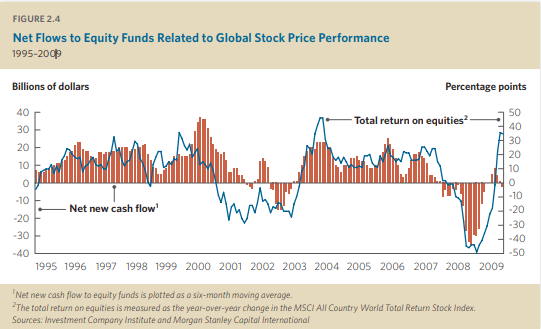
Take a look at the outflows from equity funds during down markets.

Just before the end of the financial crisis in 2008-2009, net flows into equity funds were hitting negative $200 Billion. Just when the market was bottoming, many investors threw in the towel. They were sick of getting sticker shock every month and ran for the exit. 
outflows recency

There were certainly reasons to be scared at that time. However, quality companies with pricing power endured. Just like that sweater that felt great on your skin, they were on clearance and very few investors wanted any part in owning them.

Recency Bias Causes Investors to Buy High
investors pay too much

The opposite thing happens in the midst of a bull market.

Instead of getting your statement and feeling pain you are overjoyed that the companies that you have in your 401k have gone up in value. Or you are hearing from the news that the market is going up, up, and away.

You fear you are missing out and want to ride the wave of investor enthusiasm to the stratosphere, and you want to jump in with both guns blazing.

The market is going to just keep going up, and you fear that you are missing out. You might not have had much interest a year ago when the market seemed like it was just going to keep falling like a rock, but now… 

Things are different! 

Now that equity prices are trending higher, you want to get back into the market. 

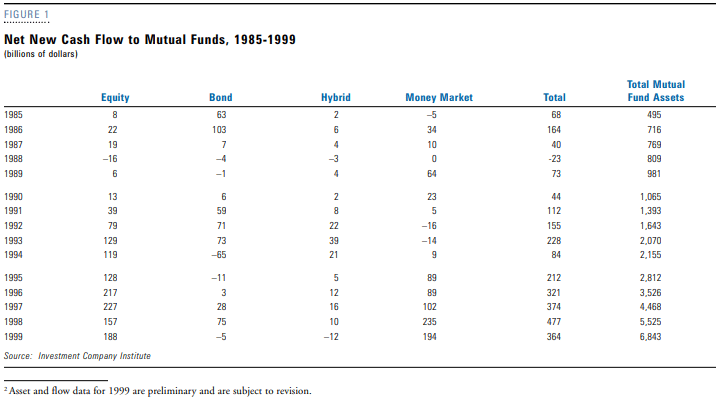
This recency bias can be seen with respect to inflows into mutual funds during bull markets.

In 1999, net new cash flows to equity funds were +$188 billion. This was just as the market was peaking during a long-term bull market. From 1987 to 1999, mutual fund assets had grown from $769 billion to nearly $6.9 trillion. The recency bias of a seemingly permanent bull market had made investors complacent, and they just wanted in no matter what the price.
recency bias inflows
Most of us experience FOMO (fear of missing out) from time to time. When the stock market is in the middle of an upswing, you are driven to make that easy money. 

And it is always a good time to own a quality company that has pricing power. But wouldn’t it be more rational that people would want them when they are on sale.

It might make more sense, but few investors do this!

Net Impact of Emotional Investing

underperformance skinny pig

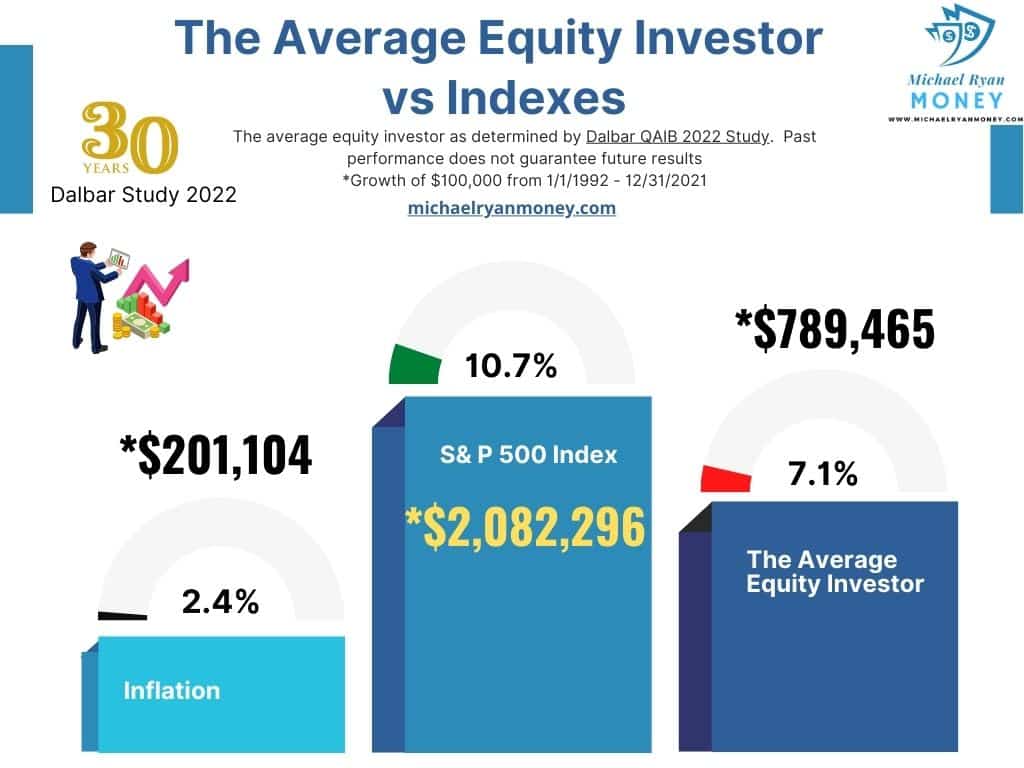
Reacting to recent events costs investors dearly. Selling low and buying high because of what happened yesterday causes long term underperformance.

In fact, had you invested $100,000 and achieved average returns since the start of 1992 your investment would have been worth over $2,000,000 at the end of 2021. The average investor, however, would have only seen that value grow to $789,465. The main reason for that underperformance is neither trading fees, nor asset management fees. Rather, as the Dalbar QAIB 2022 study shows, it is that the average equity investor does a bad job of market timing. They buy high and sell low time and time again due to recency bias.
recency bias causes underperformance

Investors that have been able to overcome their own urge to sell in a panic and overreact to raging bull markets have done much better than their peers. By staying in the market, no matter what the recent news has been, investors historically would have had much more money over the long run.

How To Overcome Recency Bias

overcoming recency bias

Research and knowledge breeds confidence!

Clearly, staying in the market ,historically, is the way to go. But you need a guide.

Without a trusted financial advisor, you may well fall into this recency bias trap just like millions of your peers.

With a cumulative 90 plus years of investment experience in our firm, the only way to stay calm in a sea of volatility is from performing due diligence.

Research, research, research…

Research is at the heart of everything we do as investment professionals at Dupree Financial Group, LLC. We have intimate knowledge about the companies in which we invest. We understand how these companies add value for their customers. And only through understanding their business model, and their long-term value, can we effectively help you overcome recency bias.

This hard, disciplined work gives us the confidence to stay invested for the long term no matter what the current investment climate.

The stock market goes up and down… good companies endure.

Just like that sweater that feels so good against the skin and goes well with your wardrobe, when we find a company that is on sale and fits so well with our clients’ investment portfolios, we want to buy it when it is on sale.

Contact us today to get a no-obligation look at your investment portfolio. It is always a good time to get sage advice from an experienced investment professional.
Value Investing Redefined

Have you seen our report? Get it in your email now!

We are diligent researchers. We aim to keep you informed every step of the way so you can feel confident that you’re making sound financial decisions. Our latest report provides an overview of the considerations and potential benefits of value investing-redefined.

Call Us Today!