The Financial Hour · Hour 2 · October 31, 2026
Why Do Stocks Fall After Good Earnings? Algorithms, Short Sellers and the Midterms
The Tom Dupree Show | Dupree Financial Group | dupreefinancial.com | 859-233-0400
By Tom Dupree, Founder, Dupree Financial Group, with James Dupree, Analyst, and Elizabeth Dupree
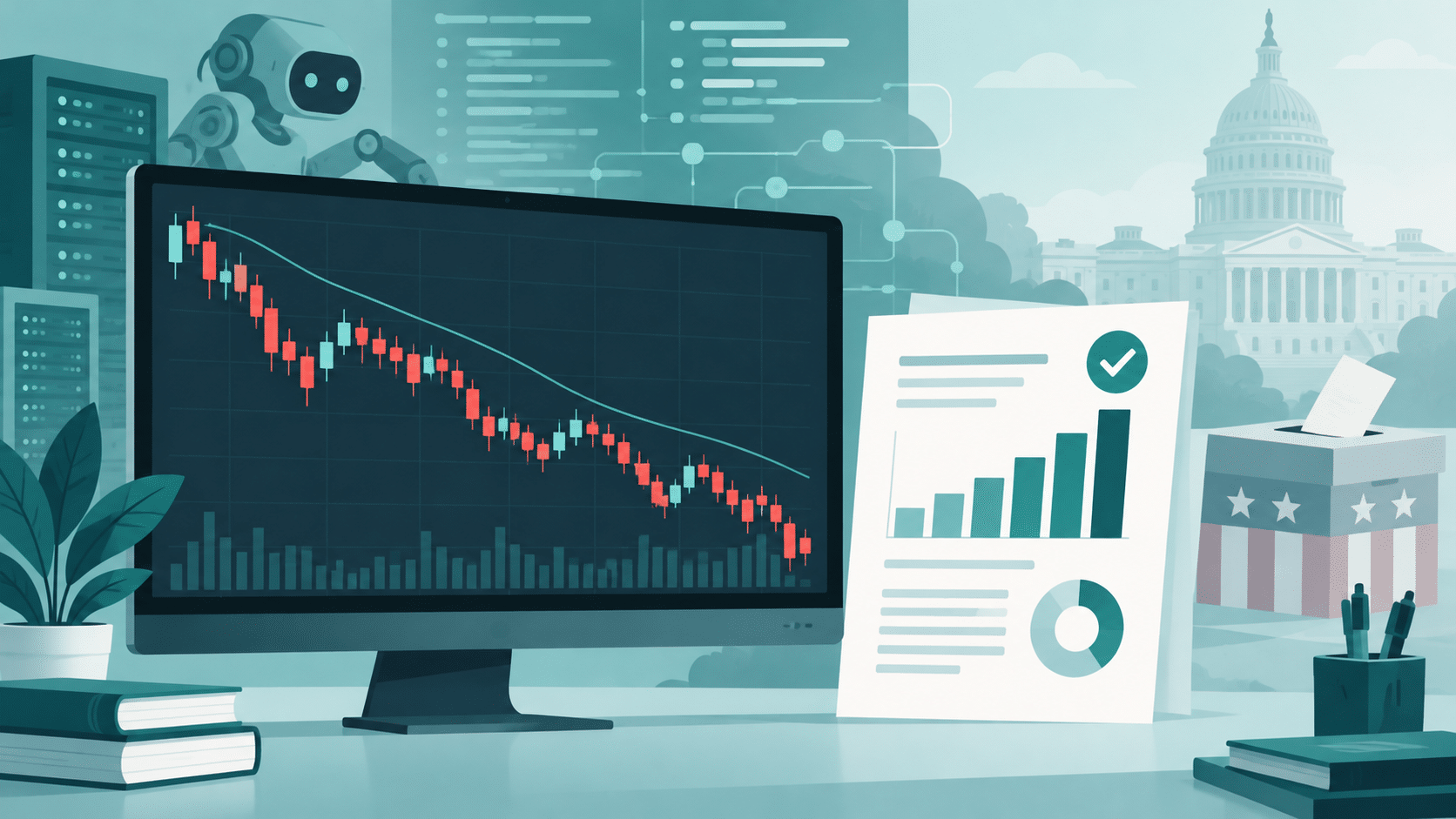
A company beats Wall Street’s profit forecast. It raises its outlook for next quarter by more than half. And the stock closes the day down 9.5%. If you watched something like that happen on your screen this week and thought, “What is going on?”, you are not alone. Here is the short answer: right now, a big share of daily trading is driven by computer programs and short sellers reacting to the overall economy, headlines and next week’s midterm elections, not by people studying what an individual company actually earns. When that happens, good companies get sold right alongside troubled ones.
On this episode of The Financial Hour of The Tom Dupree Show, a full house of Duprees sat down on a Friday afternoon. Tom Dupree, James Dupree and Elizabeth Dupree started with young musicians and the new economics of the music business. Tom then stepped away from the markets to talk about antisemitism, the midterm elections and why he believes young Americans need to know their history. In the second half, Tom put James front and center to explain what is really moving tech stocks, and what it all means if you are living on your portfolio.
Key Takeaways
- Price and value can split apart for a while. James walked through a company that blew past expectations and still closed down 9.5% on the day.
- Machines are doing a lot of the selling. Tom and James described computer-driven traders, often called algos or pods, that buy and sell whole groups of stocks as one basket.
- Short sellers and options dealers can push prices further than the news justifies. That is market mechanics, not a verdict on the business.
- Money has been moving toward dependable, dividend-paying companies. Large consumer names such as Procter & Gamble and Johnson & Johnson drew buyers during the tech sell off.
- Tom urged listeners to vote their conscience on Tuesday. He did not tell anyone how to vote, but he did say being part of the process is part of being a citizen.
Young Musicians and the New Economics of Making a Living
The hour opened with music from two young artists, Sierra Ferrell, a Grammy Award winner from West Virginia, and Shakey Graves, from Austin, Texas. That led to a conversation about how hard it has become to earn a living in music, even for a star.
The hosts pointed to a recent interview with Vince Gill, who talked about how royalty checks have dried up. Songs get streamed online without much pay coming back to the artist, and very few people buy albums anymore. Today the money is mostly in touring and merchandise. Vinyl records have made a comeback, but that is a small slice of music listeners.
The younger generation has a different playbook. Instead of music videos, they post short clips on Instagram and TikTok, talk directly with fans and build a brand first, then figure out how to make money from it. The hosts brought up Stella Lefty, whose father co-founded Groupon. She has taken criticism as a so called “nepo baby,” but she built her following through short videos, and her song “Boston” climbed to No. 2 on the Billboard Hot 100. The verdict around the table: family connections may open a door, but she still had to do the legwork. That landed close to home for a family firm where, as the hosts joked, more than one Dupree is in this business because of Dad.
Later in the hour, Tom came back to the musicians at the bottom of those long festival posters you see in coffee shops, the ones probably making about 50 bucks a show and holding down a regular job to keep playing. “They have to love it,” he said. “That’s the bottom line.”
Tom on Antisemitism, the Midterms and Knowing Your History
Tom said up front that he was going to talk about something other than the market, at least for a while. He started with a Wall Street Journal column by Matthew Continetti titled “Antisemitism Is on the Ballot,” which argues that the midterms will measure the country’s resistance to an ancient hatred.
Continetti’s column focuses on Michigan’s U.S. Senate race between Democrat Abdul El-Sayed and Republican Mike Rogers, a former FBI agent and congressman, and on a one minute ad that ran in the state. As Tom read it, the ad shows a married couple in a grocery aisle. The wife tells her husband to put a carton of eggs back because they have to set that $7 aside “for killing Palestinians.” The ad’s message is that Rogers cares more about Israel than America. It was produced by Cenk Uygur of The Young Turks, the uncle of streamer Hasan Piker, and according to the column it has been condemned for dual loyalty accusations, demonizing Israel, economic illiteracy and antisemitic tropes. Tom noted that many Democrats have criticized the ad too, including Michigan Senator Elissa Slotkin, who is Jewish and supports El-Sayed.
Tom said this is a message he sees across the country, in protests and Palestinian flags, and among young men in their twenties, including one of his own sons, who he said often questions the Jewish presence in America. To Tom, it points to a lack of understanding of history and of America’s roots in people informed by the Bible.
“Without Judaism, there would be no Christianity. Without Christianity, there would be no America. That’s a fact.” Tom Dupree
He talked about the colonists who came seeking religious freedom from governments that allowed only one church, the lives sacrificed to build the country, and the years under the Articles of Confederation before the states came together as a nation. His concern is that most young people, even college educated ones, do not know that story, which leaves them open to ideas like antisemitism. With Election Day set for Tuesday, November 3, he made a plain request.
“I’m urging people to vote your conscience. I’m not gonna tell you how to vote.” Tom Dupree
He added that many people in their twenties never register to vote because they do not think it matters. “It’s part of being a citizen,” Tom said. “It really is.”
How Do Young Americans Feel About Their Country?
Tom then turned to a piece on RealClearPolitics by Democratic strategist Mark Penn, who asks whether the kind of unrest France has seen could happen here. Penn’s point is that young Americans have more education, better technology, greater opportunity and higher living standards than ever, and yet many are souring on America. He notes that the number of young college graduates rose 75% between 1993 and 2023, and that young women, who have largely closed the pay gap and are now a majority of students in college, law school and medical school, lead the way in negative attitudes toward the country.
The numbers Tom read from Penn’s article come from Harvard CAPS Harris polling: 74% of Americans have a favorable view of the U.S., but among adults ages 18 to 24 that falls to 52%. Among Democratic voters under 30, only 41% view the country favorably, compared with 79% of young Republicans, and young women are roughly 15 points less favorable than young men.
Tom’s take is that many young people are not living in reality about what America offers, and are not part of the process. Put the drift toward socialism together with the drift toward antisemitism, he said, and what it points to is ignorance about who we are. Speaking as a Christian, he said following Christ sometimes means telling the truth when it is unpopular, and he believes some Democratic leaders are misleading young people whom the education system has already failed. His encouragement: pick up a Bible, start reading and understand the country you come from.
His co-hosts pushed back with a fair question. Is the problem a lack of leadership, or could strong leaders, people like Tom with firm opinions, make it easier for others to sit back and let someone else handle it? Tom answered that he rarely talks about these things on air, that there are far more powerful people than him, and that ultimately people have to think for themselves. “In order to do that, they have to have the facts,” he said. The conversation closed on a shared worry about a lack of intellectual curiosity, and how much thinking we now hand off to the devices in our hands.
Who Is Really Trading Your Stocks?
Back to the market. Tom opened the second half by noting a massive sell off in Intel, which he said was down something like 30% at one point. James’s view was that Intel never should have been trading around $140 in the first place, so that drop was a valuation story. But Tom wanted to talk about something else: stocks that trade in patterns that simply do not make sense.
“Do not suspect that this is being driven by human beings, because it is not.” Tom Dupree
Tom explained that much of today’s buying and selling comes from computer-driven traders that people call algos, short for algorithms, or pods. FINRA, the brokerage industry’s regulator, treats these algorithmic trading strategies as their own area of oversight because they generate and route orders automatically. These programs can bet on a stock going up or down. Tom described seeing sell orders for 40,000 shares from traders who could not possibly own that much stock. They are selling short.
A short sale is simple in concept. The SEC’s investor site defines it as selling a stock you do not own, betting the price will fall so you can buy it back cheaper later. The seller borrows the shares to make delivery, and as Investor.gov explains, brokerage firms typically lend that stock from their own inventory or from other customers’ margin accounts. Tom put the risk in plain terms: if the market moves the wrong way, a short seller has to buy their way back out. He said there are telltale patterns in the trading that give away a machine instead of a person, and James gets genuinely upset watching it because he sees how little sense it makes.
How Can a Stock Fall After Beating Earnings?
James walked through a company he follows that reported this week. He did not name it on air, but the numbers tell the story:
- Gross margin: Wall Street expected 43%. The company posted 56%. In plain English, that is how much the company keeps from each sale after the cost of making its product, and it came in well above forecasts.
- Revenue: Quarter over quarter, sales almost doubled.
- Guidance: For next quarter, the Street expected 36 cents of earnings per share. The company guided to 59 cents, a beat of more than 60%.
Earnings per share is simply a company’s profit divided by the number of shares outstanding. Guidance is management telling you what it expects next quarter, and James said that for a fast-growing tech company, guidance is pretty much all that matters, as long as you trust the company to execute. The stock was down as much as 15% during the day and closed down 9.5%.
James’s view is that in a bull market, a report like that would have sent the stock sharply higher, because short sellers would have been forced to admit they were wrong and buy shares back. Instead, he said, humans do not want to step in front of the midterms, and the algorithms trade “macro,” meaning they lump companies together. If Intel is down 30%, it is very hard for a small semiconductor company in the same basket to go up, even if Intel’s problems are Intel’s alone.
Smaller companies get hit hardest. They have less liquidity, meaning fewer shares trading hands, and less of what Tom used to call sponsorship: fewer big firms standing by as ready buyers to support the price.
What Are Moving Averages, and Why Do Traders Watch Them?
James explained technical analysis, which is reading a stock’s price chart rather than its financial statements. The three moving averages he called most important are the 21 day (short term), the 50 day (medium term) and the 200 day, which he described as the line a stock really has to hold. A moving average is just the average closing price over that many days, updated daily.
The pattern he described goes like this: lose the 21 day and a stock will probably head to the 50 day. Lose the 50 day and it will probably head to the 200 day. Below the 200 day, it is what traders call price discovery, where buyers and sellers simply have to figure out what the stock is worth. When Tom asked about the 200 week average, James said weekly averages matter a lot too, and that for some of his stocks he has had to go all the way to monthly charts to find support. Tom’s dry reply: “Price discovery.”
There was good news in the trading, though. James said the momentum names made higher lows, meaning they did not fall below where they bottomed a week or two ago, and that is a constructive sign. He explained that money managers buying fast-growing companies prefer to buy strength, not weakness. Buying on weakness is trying to pick the bottom, and a broken trend can keep breaking.
How Do Options Move Stock Prices?
There is another layer underneath all this: options. The SEC’s introduction to options explains that the two most common contracts are calls and puts. James said options are especially popular on volatile momentum stocks, and he gave a hypothetical example.
Say a market maker sold a $55 put, and the stock is trading at $56. If the stock breaks below $55, that dealer has to sell the stock to cover their position, which pushes the price lower still. It works the same way on the way up. Dealers who sold calls have to buy the stock once it rises above the strike price, which can drive it higher. That is called a gamma squeeze.
“It’s all market mechanics. It has nothing to do with the fundamentals of the company.” James Dupree
Headlines, the AI Trade and the Busted Toys
James also pointed to a Financial Times report, published in the week leading into the midterms, saying that Anthropic has junk bonds. James said Anthropic’s S-1, the registration statement a company files with the SEC before going public, said otherwise; he believes the European Union is trying to cause chaos ahead of the midterms. He called the report corrupt, and Tom agreed. Tom asked whether something new had come to the surface. James’s answer was that there are leaky layers everywhere, and the market runs with whatever headline appears. Anthropic is not yet publicly traded, so you cannot short it, but James said any negative headline becomes a reason to sell everything AI-related.
His view is that most long-term holders with a real thesis are not the ones selling. Tom added an important reminder: every time someone sells short, somebody else is on the other side buying at the lower price. And once a stock is heavily shorted, there is only so much more shorting that can happen.
“There are gonna be some bargains in this pile of busted toys. And the question is gonna be who’s gonna find them and who’s gonna be willing to step up.” Tom Dupree
James expects the picture to get clearer after the midterm elections. “Once that happens, then fundamentals can take over, and then you buy businesses,” he said. “You don’t buy a chart.”
Why Is Money Moving to Procter & Gamble and Johnson & Johnson?
Tom noted that earlier in the day money was moving toward traditional names like Procter & Gamble and Johnson & Johnson. Not because they suddenly became exciting. Procter & Gamble has been a low-growth company for a long time. It is a flight to quality: dependable businesses that keep generating cash flow. James said the biggest move came on Thursday, a big risk-off day for tech, when buyers bid up those defensive stocks, and added that DFG holds a lot of them in its portfolios.
That is the reframe for anyone living on their investments. Everything James described about growth and AI stocks applies to value and dividend investing too. In the end, it comes down to the fundamentals of the company and, for retirement investors, the income it throws off. Tom said plainly that it is never going to be perfect, but DFG tries to balance it. The bond allocation has been acting better lately, with prices going up and yields going down, and the firm still expects to get growth out of its technology names in time, as it has before.
As the hosts noted, the show records on Friday afternoon, so “today” and “yesterday” mean Friday and Thursday. And the political backdrop matters. James said the market right now is driven less by individual companies and more by the overall economy. Investors are looking 12 to 18 months down the road, not at next quarter, which is why they have been buying consumer cyclical stocks. Why those in particular?
During the break, Tom’s own spot summed up why this matters if you are retired: “Inflation doesn’t retire when you do, and a volatile market doesn’t care about your timeline.” A portfolio built around companies that pay and tend to grow their dividends is designed to give you income that has a chance to keep up, whatever the market is doing that week. All investing involves risk, including the potential loss of principal, and dividends can be reduced or stopped. That is why it pays to understand the investment philosophy behind what you own.
What Should You Do When the Market Stops Making Sense?
- Know what you own and why you own it. Pull up your statements and list each holding next to the reason you bought it. If you cannot fill in the reason, that is your first conversation.
- Separate the business from the stock price. Look at what a company is actually earning and paying out, not just how its chart looked this week.
- Check where your income comes from. Add up the dividends and interest your portfolio pays in a year. That number, not the daily balance, is what pays your bills in retirement.
- Look at your balance between stocks and bonds. Bonds can provide current income, lower volatility and cash for buying when good companies go on sale.
- Do not let headlines drive your decisions. As this episode showed, a lot of daily selling has nothing to do with the companies themselves.
- Get a second set of eyes. A personalized portfolio analysis can show you exactly how your holdings are positioned heading into the election and beyond.
Frequently Asked Questions
Why would a stock go down after a strong earnings report?
A stock can fall after good results when the overall market is selling. On this episode, James Dupree explained that computer-driven traders group similar companies together, so bad news at one company, or worry about the economy and the midterms, can drag down a business that just reported strong profits and raised its guidance.
What is short selling?
Short selling means selling a stock you do not own, usually by borrowing shares from a brokerage firm, with the hope of buying them back later at a lower price. If the price rises instead, the short seller loses money and may have to buy shares back quickly, which can push the price even higher.
What is a moving average on a stock chart?
A moving average is a stock’s average closing price over a set number of days, such as 21, 50 or 200 days, updated every day. Traders watch these lines as possible support levels. When a stock closes below one, many traders expect it to drift toward the next, longer average.
What is a flight to quality?
A flight to quality happens when investors move money out of riskier, faster-growing stocks and into dependable companies with steady cash flow, such as large consumer goods makers. Tom Dupree noted that this kind of move, not excitement about growth, explained recent buying in names like Procter & Gamble and Johnson & Johnson.
Should retirees change their investments before an election?
Elections can add short-term volatility, but reacting to headlines is rarely a plan. A better step is reviewing what you own, why you own it, and how much income it produces. Everyone’s situation is different, so it makes sense to talk with a fee-only fiduciary advisor before making changes.
The market can stay strange longer than any of us would like. Machines will keep trading baskets, short sellers will keep chasing headlines, and the midterms will come and go on Tuesday. What does not change is that over time you own businesses, not charts. If you don’t know what you own in your portfolio, you need to, and we can help. Call Dupree Financial Group at 859-233-0400, visit dupreefinancial.com, or schedule a complimentary portfolio review directly online. You can catch every episode in the Tom Dupree Show podcast archive.
The information presented on this program is believed to be factual and up-to-date, but we do not guarantee its accuracy, and it should not be regarded as a complete analysis of the subjects discussed. Dupree Financial Group is a registered investment advisor, registered with the Securities and Exchange Commission. All information presented on this program is for educational purposes only and does not constitute investment advice, a solicitation, or a recommendation to buy or sell any security. Any references to securities or market performance are general in nature. Investing involves risk, including the potential loss of principal. Past performance is not indicative of future results. Please consult with a qualified financial advisor before making any investment decisions.