Is Your Retirement Portfolio Too Concentrated?
A 25-year-old hedge fund manager lost roughly $35 billion in a matter of days this week. Here’s what his leverage and the market’s concentration in seven stocks have to do with your retirement account.

This week, a 25-year-old former OpenAI researcher named Leopold Aschenbrenner watched roughly $35 billion disappear from his hedge fund in a matter of days. Two years ago, he wrote a 165-page essay predicting the future of artificial intelligence with such confidence that Silicon Valley treated it like scripture. This week, his fund — built on borrowed money layered on top of a handful of AI stocks — got forced into a fire sale to Ken Griffin’s Citadel at a steep discount.
It’s a dramatic story. But here’s the direct answer to the question that actually matters for your retirement: if most of your money sits in a plain S&P 500 index fund, you may be more concentrated in a handful of the same stocks than you realize — and that concentration, not any single hedge fund’s collapse, is the real thing worth understanding before your next portfolio review.
You don’t need borrowed money or a 165-page manifesto to be exposed to this. You just need to own “the market” and assume that means you’re spread across 500 different companies.
Key Takeaways
- Leverage magnifies both directions. Borrowing money to buy investments can boost gains on the way up, but it can wipe out capital just as fast on the way down. That’s the entire story of this week’s hedge fund collapse.
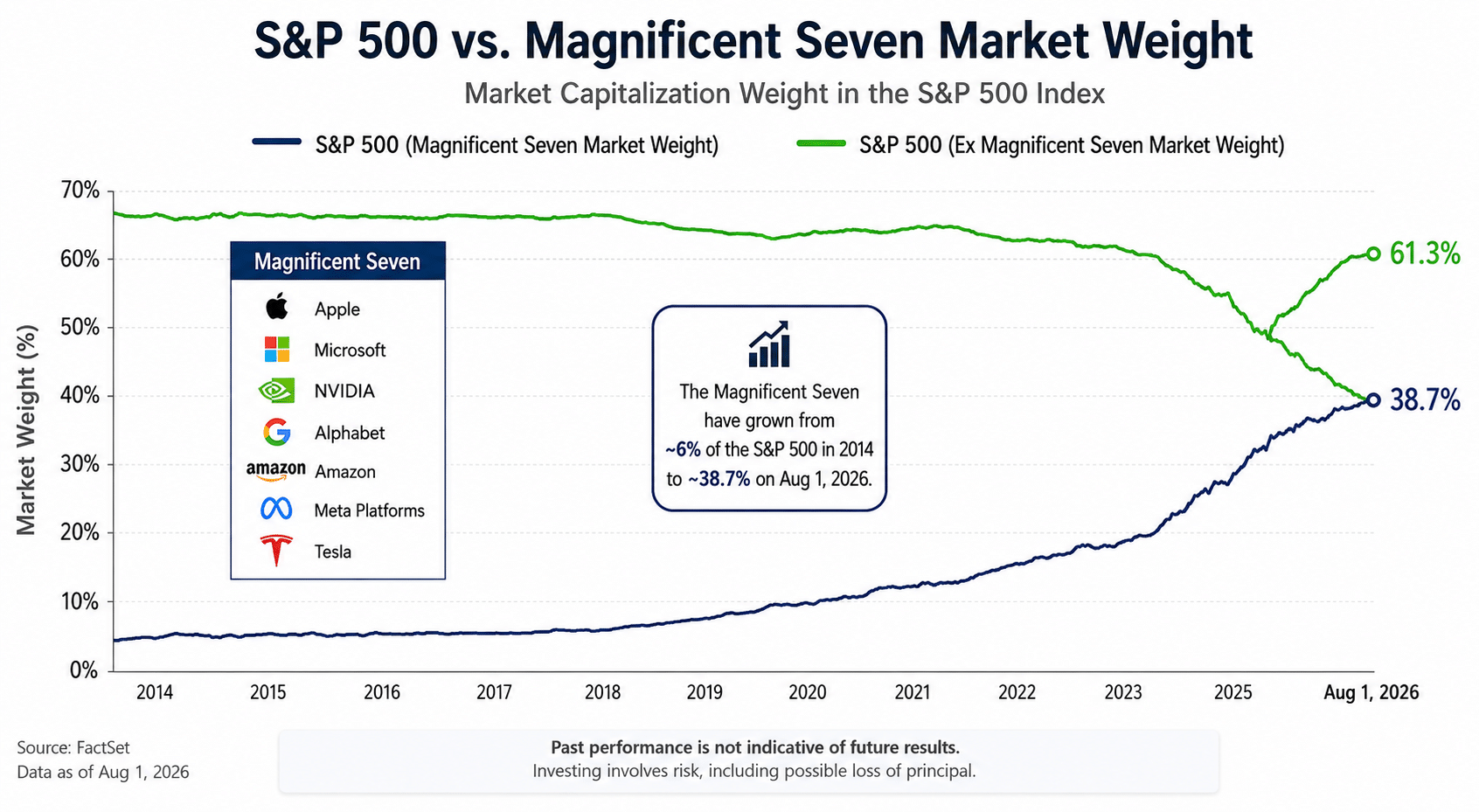
- Seven stocks now make up a large share of the S&P 500. Depending on the week you check, the “Magnificent Seven” technology stocks account for somewhere between a third and roughly 40% of the entire index’s value.
- Owning an index fund is not automatically owning a diversified portfolio. A market-cap-weighted index gives its biggest companies the biggest influence — so when those companies wobble, so does “the market.”
- Know what you own and why you own it. That’s not a slogan — it’s the single most useful question a retiree can ask before the next headline-grabbing selloff.
Why This Week’s Story Is Bigger Than One Hedge Fund
Every generation produces an investor who seems untouchable — brilliant, early to a trend, riding a wave everyone else is still arguing about. Aschenbrenner’s fund, Situational Awareness, reportedly grew from roughly $200 million to as much as $45 billion in under two years, largely on concentrated bets in AI infrastructure names. Then, using leverage reported as high as 400% — meaning roughly four borrowed dollars for every dollar of the fund’s own capital — a sharp pullback in a handful of semiconductor and AI stocks triggered margin calls his prime brokers couldn’t ignore.
That’s the mechanical part, and it’s worth understanding in plain English: when you borrow against an investment and that investment drops in value, your loan doesn’t shrink with it. At some point the lender requires more collateral — a margin call — and if you can’t provide it, your shares get sold for you, often at the worst possible moment. There’s no easy way around that math. It requires diligence, not confidence.
Most retirees reading this aren’t using 400% leverage. But there’s a quieter version of the same concentration problem sitting inside a lot of 401(k)s and IRA rollovers, and it doesn’t require a single dollar of borrowed money to hurt you.
What the Numbers Actually Show
According to CNBC’s reporting on the collapse, Aschenbrenner’s fund held roughly $45 billion in assets at its peak, before margin calls forced the sale of its leveraged public stock positions — including major holdings like SK Hynix and CoreWeave — to Citadel at a discount, with the fund’s overall assets falling to around $10 billion within about 30 trading days (CNBC). TechCrunch’s coverage confirms Aschenbrenner had no prior professional trading experience before launching the fund in 2024, and that the losses came from both AI stocks falling and short positions in software companies moving the wrong way at the same time (TechCrunch).
Meanwhile, the broader market has its own version of this concentration story. Reporting from Forbes notes that the “Magnificent Seven” technology stocks made up roughly a third of the S&P 500’s total market capitalization heading into 2026, with some advisors calling the resulting concentration risk a “legitimate concern” (Forbes). Separate reporting from CNBC put the figure as high as 35% to 40% of the index in recent trading, prompting some strategists to recommend equal-weighted alternatives to reduce that concentration (CNBC).
The SEC’s own investor education office has published plain-language guidance on why borrowing to invest carries risks that go beyond the investment itself — including the fact that a broker can sell your securities to meet a margin call without waiting for you to act, and can do so without advance notice (SEC Investor.gov). It’s the kind of guardrail worth reading once, even if you never plan to use margin yourself.
“Leverage is a thing to be used very judiciously and very carefully, because if you use it in a way that’s irresponsible, it can cost you everything.” — Tom Dupree
The Reframe: This Isn’t a Bet on Whether AI Wins or Loses
Most of the commentary this week has been framed as a debate: Is AI spending going to pay off, or is it a bubble? That’s an interesting argument, and reasonable people disagree about it — Microsoft’s stock jumped double digits on one earnings report this year, while Oracle’s bonds have drawn scrutiny over its own AI-related spending. But that debate is largely beside the point for a retiree building income for the next 40 or 50 years.
The actual lesson isn’t “buy AI stocks” or “avoid AI stocks.” It’s that when a market’s returns get concentrated in a small number of companies, your risk gets concentrated right along with it — whether you meant it to or not. That’s exactly why our approach starts with cash flow analysis, not headlines: dividend-paying companies across sectors like insurance, telecommunications, and financials keep generating income whether or not seven technology companies are having a good month. You get paid to wait, in good markets and choppy ones, instead of hoping a narrow slice of the market keeps carrying the whole index.
What This Looks Like in Practice
We build separately managed accounts around companies with a history of paying and growing their dividends, purchased when they’re out of favor and less expensive — not around chasing whichever seven stocks are dominating the headlines that quarter. Bonds play a role too: current income, lower volatility, and dry powder to buy good companies when the market temporarily marks them down for reasons that have nothing to do with their underlying business.
None of this means avoiding growth, and it doesn’t mean the S&P 500’s biggest companies are bad businesses — several of them are genuinely excellent. It means not letting one basket, however impressive, decide the outcome of your retirement. All investing involves risk, including the possible loss of principal, and no strategy removes that risk entirely. The goal is to understand it, size it appropriately, and build income you don’t have to sell into a downturn to access.
Five Things to Check in Your Own Portfolio
- 1Pull up your 401(k) or IRA’s top ten holdings. Most plan providers list this on your statement or online dashboard. If you don’t see it, call and ask — it’s your money, and you’re entitled to know.
- 2Add up what percentage those top ten represent. If it’s a plain S&P 500 index fund, expect a meaningful chunk of your total to be concentrated in a handful of names, most of them technology companies.
- 3Ask whether that concentration matches your risk tolerance at your stage of life. A 35-year-old accumulating wealth can absorb more concentration risk than someone drawing income in retirement.
- 4Check whether you’re using any form of leverage or margin, even indirectly through certain funds or products, and make sure you understand exactly what happens if those positions move against you.
- 5Get a second set of eyes on the whole picture. It’s easy to know your account balance and much harder to know what’s actually driving it. That’s the gap a complimentary portfolio review is built to close.
Frequently Asked Questions
The Close
By the time you read this, Leopold Aschenbrenner’s fund will likely have faded from the headlines, replaced by whoever’s turn it is next — because, as history keeps showing us, there’s always a next one. But the question his week left behind isn’t really about him. It’s about whether you know what you own, and whether you’d be able to answer calmly if your own portfolio had a bad week.
That’s the whole point of retiring on income instead of hope: you don’t need to guess right about which seven stocks win. You need a plan that keeps paying you regardless.
Keep Learning
- Listen to the full episode — hear Tom, James Dupree, and Michael Dawahare walk through the Mag Seven earnings debate and this week’s market moves in more detail.
- Learn more about Dupree Financial Group — our fee-only, fiduciary approach and the team behind it.
- Schedule a complimentary portfolio review — see exactly how concentrated your own accounts are today.
About The Tom Dupree Show
The Tom Dupree Show is hosted by Tom Dupree, founder of Dupree Financial Group and a 47-year veteran of the investment business. Each episode covers the financial topics that matter most to retirees and those approaching retirement — in plain English, without the Wall Street spin.
Dupree Financial Group is a fee-only, fiduciary Registered Investment Advisory firm based in Lexington, Kentucky. The firm manages separately managed accounts focused on income-generating, dividend-paying portfolios — no products sold, no commissions, no conflicts of interest.
Past episodes are available at dupreefinancial.com under the Radio tab.
If you’re not sure whether your retirement account is more concentrated in a handful of stocks than you’d like — we’ll take a look. No charge. No pressure. Just an honest conversation about what you own and whether it’s working for you.
All investing involves risk, including the possible loss of principal. Past market performance discussed above refers to historical index and company data, not to the performance of any Dupree Financial Group account.
Dupree Financial Group is a Registered Investment Advisor (RIA) registered with the Securities and Exchange Commission. Registration does not imply a certain level of skill or training. The information presented on this program is for educational purposes only and does not constitute investment advice, a solicitation, or a recommendation to buy or sell any security. Investing involves risk, including the potential loss of principal. Past performance is not indicative of future results. Please consult with a qualified financial advisor before making any investment decisions.