Why Is the 30-Year Treasury Yield the Highest Since 2007 — And What Does It Mean for Your Retirement Income?
Episode Description
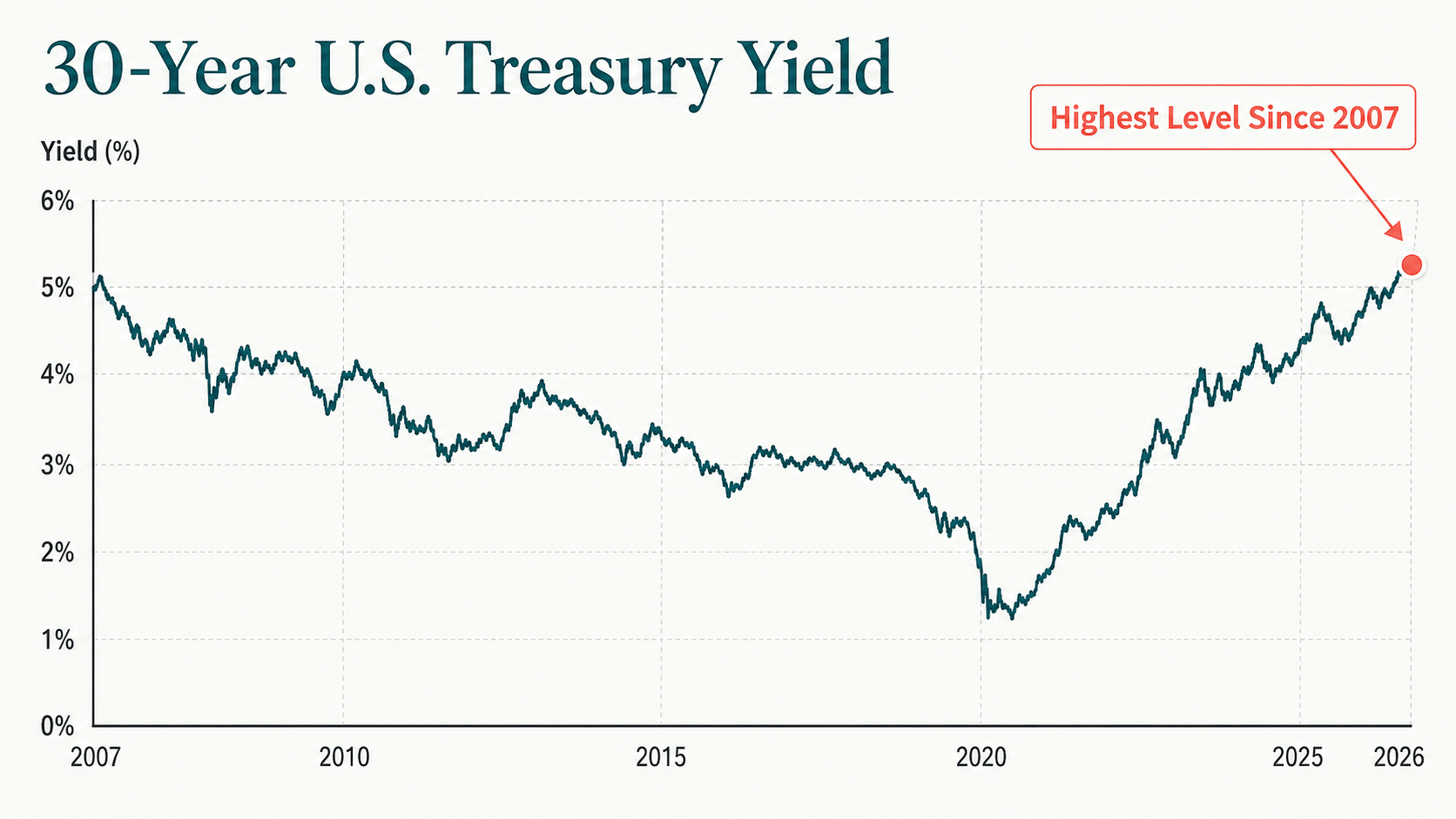
On August 17 and 18, 2026, the yield on the 30-year U.S. Treasury bond climbed above 5.3% — its highest level since 2007, back when the iPhone hadn’t even shipped yet and the word “subprime” was just entering the public vocabulary. On this week’s Financial Hour, Tom Dupree, Mike Johnson, and Michael Dawahare broke down why that number matters, what the U.S. Treasury Department is doing about it, and — more importantly — what it means for anyone who’s retired or approaching retirement and living off a portfolio.
The team walked through Treasury Secretary Scott Bessent’s decision to expand the government’s bond buyback program, why the Treasury is repurchasing old, low-coupon “off-the-run” bonds, and what Bessent meant when he said he has “asymmetric information” the market doesn’t. Mike Johnson explained the mechanics in plain terms: the Treasury doesn’t hold these bonds on its balance sheet the way the Fed does — it swaps them out and reissues shorter-term debt, which theoretically frees up the plumbing in the bond market without actually solving the underlying supply-and-demand problem driving yields higher in the first place. The U.S. Treasury’s own announcement confirms the buyback size is at least doubling, from a $2 billion to a $4 billion per-operation ceiling, effective September 9, 2026 — exactly the increase Tom, Mike, and Michael were reacting to on air.
From there, the conversation turned to what’s actually happening underneath the surface of the stock market. Economist Ed Yardeni’s “K-shaped economy” — where some parts of the economy do well and others fall behind — is evolving into what he now calls a “G-shaped economy,” with earnings-driven strength showing up in previously out-of-favor sectors. Coca-Cola hitting an all-time high the same week Walmart’s stock dropped roughly 10% on strong-but-complicated earnings was Exhibit A. Tom and the team also discussed two specific holdings in DFG client portfolios — a commercial real estate mortgage REIT and Verizon — and why research-driven, patient investing in “forgotten” sectors has been paying off for income-focused clients this year.

On the mortgage REIT position, the team went deeper than “buy the dip.” The company — sponsored by a large institutional manager with global real estate data and research reach — makes commercial real estate loans, historically concentrated in office properties. When one or two of those loans showed early warning signs, the company increased its loan-loss reserves, which shows up on paper like a write-down even though the loan stays on the books and no cash has actually been lost. The stock sold off on the news. Tom and Mike explained why they added to the position instead of walking away: this management team was conservative during the “nuclear winter” for office real estate a few years ago, has since been letting legacy office loans run off, and is redeploying that capital into multifamily, healthcare, and industrial loans — property types with materially better performance right now. Because these are shorter-duration loans, the portfolio’s characteristics can shift relatively quickly as old loans mature and new ones get written. That combination — a real dividend yield in the double digits today, a management team with a track record of conservative accounting, and a portfolio actively repositioning into stronger property types — is why DFG treated the sell-off as a buying opportunity for income-focused clients rather than a reason to sell.
Verizon came up for a different reason: SpaceX’s Starlink satellite service and the ongoing question of whether it can realistically compete in the cellphone business. Mike and Tom were skeptical, pointing to a CNBC analyst’s explanation that a satellite-based “cell tower” sits roughly 220 miles away compared to the two or three miles most people are used to today — a gap that raises real questions about latency and practicality for everyday phone calls, whatever the marketing promises. What both hosts agreed on is that the more durable asset is compute capacity: Starlink’s parent currently leases out some of that capacity, with the option to use more of it for its own future needs, not unlike how Amazon Web Services has become a larger and more important piece of Amazon’s business than its original retail operation.
The team also used Walmart’s earnings reaction as a pulse check on the broader consumer. Despite what management called one of its healthiest quarters, the stock dropped roughly 10% the day of the release — driven largely by new government pricing rules on pharmaceuticals that took effect in the second quarter, layered on top of a business that’s now roughly half grocery. Because the market had to digest several moving pieces at once, short-term traders reacted to the complexity rather than the underlying strength Walmart itself described on the call. On the broader consumer picture, Mike Johnson noted wage growth is positive for the first time in a while, and inflation and affordability on goods have ticked slightly better — partly offset by a 20–30% rise in gas prices over the past month. The team also flagged a rollback of tariffs on beef imports from South American trading partners, aimed at easing supply after herd sizes shrank in recent years — welcome relief on one grocery bill line item, even as lower-income households continue to feel the most pressure on housing, auto, insurance, and everyday food costs.
Tom also used part of the hour to deliver a message he called maybe the most important thing he’d say all year: it’s not how much your portfolio earns on average — it’s when the losses happen.
“Here’s something most people approaching retirement have never heard, and it could be the most important thing I say. It’s not how much your portfolio earns, it’s when it loses.”
If your retirement account drops 10% in year one and you’re already pulling money out to live on, you’re drawing from a smaller pool going forward. Do it again in year two, and — as Tom put it — “you may never recover. Even if the market bounces back, the damage is already done.” Wall Street tends to talk in long-term averages, but as Tom noted, “averages don’t pay your electric bill in a down market.” That’s the whole case for building retirement income around dividends rather than around hoping the market cooperates on your withdrawal schedule. FINRA’s own guidance on managing a retirement portfolio makes the same point: your time horizon shrinks once withdrawals begin, so reassessing how much investment risk you’re carrying — and where your income is actually coming from — matters more with each passing year of retirement.
Topics Covered
- The 30-year Treasury yield hit 5.3%+ this week, its highest level since 2007
- Treasury Secretary Scott Bessent’s expanded bond buyback program and what “asymmetric information” means for markets
- Why the Treasury is repurchasing old, low-coupon “off-the-run” bonds instead of holding them like the Fed does
- Sequence of returns risk: why the timing of a loss matters more than your portfolio’s long-term average return
- Ed Yardeni’s “K-shaped economy” evolving into a “G-shaped economy” — and what that means for stock picking
- Coca-Cola’s all-time high vs. Walmart’s post-earnings stock drop, and what each says about the consumer
- Adding to a commercial real estate mortgage REIT position on a pullback — the research behind the decision [COMPLIANCE REVIEW: episode cites a specific dividend yield figure for a named DFG portfolio holding]
- Verizon, satellite phone service, and questions about whether Starlink can really replace cell towers
- Wage growth, tariff-driven beef price relief, and the uneven affordability picture for lower-income consumers
Key Takeaways
- Timing beats averages once you’re retired and withdrawing income.
A 10% drop in year one of retirement, combined with withdrawals, shrinks the pool you have left to recover with. Tom’s point: “averages don’t pay your electric bill in a down market.” - The Treasury’s bond buyback is a Band-Aid, not a fix.
Doubling the buyback to $4 billion per operation sounds significant, but against roughly $40 trillion in outstanding debt, it’s a small lever. It briefly pushed yields down, but the market has largely looked through it. - A steepening yield curve isn’t automatically a warning sign.
The curve normalized after years of inversion — but it’s steepening because the long end is rising, not because short rates are falling, which is a distinction worth understanding rather than reacting to. - Fundamental research pays off when a market broadens out.
With mega-cap “Mag Seven” performance uneven this year, previously out-of-favor companies and sectors — Ed Yardeni’s “forgotten” names — are earning higher multiples on real earnings growth, not hype. - Pullbacks driven by loan-loss accounting, not fundamentals, can be buying opportunities.
DFG added to a commercial real estate mortgage REIT position after a stock drop tied to conservative loss reserves — a decision built on management’s track record, not on trying to time a bounce. - The consumer picture is genuinely mixed.
Wage growth is up for the first time in a while, and tariff relief on beef imports is easing some grocery costs — but affordability on housing, insurance, and everyday goods remains a real strain for lower-income households.
Frequently Asked Questions
What is sequence of returns risk, and why does it matter for retirees?
Sequence of returns risk is the danger that market losses early in retirement — combined with ongoing withdrawals — can permanently shrink a portfolio, even if long-term average returns look fine. A downturn in year one or two, while you’re pulling income out, leaves less money available to participate in any later recovery.
Why did the 30-year Treasury yield hit its highest level since 2007?
The 30-year Treasury yield crossed 5.3% in August 2026, its highest level since 2007, driven by heavy government borrowing, persistent inflation above the Fed’s target, and continued Treasury debt issuance. It marks a shift after years of historically low long-term rates following the 2008 financial crisis.
What is the Treasury doing about rising long-term bond yields?
In August 2026, the U.S. Treasury announced it would at least double its bond buyback program, from a $2 billion to a $4 billion per-operation ceiling starting September 9. The program repurchases older, low-coupon bonds and reissues shorter-term debt to help ease pressure in the long-bond market.
What is a “K-shaped” or “G-shaped” economy?
Economist Ed Yardeni’s “K-shaped economy” describes an economy where some sectors and income groups do well while others fall behind. He now calls it a “G-shaped economy” as earnings growth broadens into previously overlooked sectors, showing up in stock performance beyond the small group of mega-cap tech names.
How does Dupree Financial Group approach investing during periods of market volatility?
Dupree Financial Group focuses on in-house research into dividend-paying stocks and bonds that generate visible income, rather than reacting to short-term headlines. The firm looks for quality companies temporarily out of favor for fixable reasons, aiming to build retirement income that doesn’t depend on guessing short-term market direction.
About The Tom Dupree Show
The Tom Dupree Show is hosted by Tom Dupree, founder of Dupree Financial Group and a 47-year veteran of the investment business. Each episode covers the financial topics that matter most to retirees and those approaching retirement — in plain English, without the Wall Street spin.
Dupree Financial Group is a fee-only, fiduciary Registered Investment Advisory firm based in Lexington, Kentucky. The firm manages separately managed accounts focused on income-generating, dividend-paying portfolios — no products sold, no commissions, no conflicts of interest.
Past episodes are available at dupreefinancial.com under the Radio tab.
If you’re not sure how a rising-yield environment or a rough sequence of returns could affect your specific retirement income plan, that’s exactly what we sit down and work through. There’s no cost and no pressure — just a clear look at what you own and why.
Past performance is not indicative of future results. This material is for informational purposes only and does not constitute investment advice. Dupree Financial Group is a fee-only registered investment advisor. Investments involve risk, including possible loss of principal. Please consult with a qualified financial professional before making any investment decisions.
Dupree Financial Group is a Registered Investment Advisor (RIA) registered with the Securities and Exchange Commission. Registration does not imply a certain level of skill or training. The information presented on this program is for educational purposes only and does not constitute investment advice, a solicitation, or a recommendation to buy or sell any security. Investing involves risk, including the potential loss of principal. Past performance is not indicative of future results. Please consult with a qualified financial advisor before making any investment decisions.